
One would assume that winter’s bitter-weather would drive people away from the beach and into the warm confines of their homes, but for Fiona Parks and many other Williamstown locals, diving into chilly ocean waters is a regular early-morning activity. Lovingly known by those who frequent the spot as ‘The Crystals’, this corner of Williamstown beach is a bustling gathering place for conversation, socialisation and swimming.
Human connection is a pillar of improving quality of life and vibrant ‘Third Places’ like The Crystals are vital to maintaining the social fabric of our communities. In a world that is steadily moving towards quick and convenient social exchanges, it is increasingly important to preserve and foster our ‘third places’.
The term ‘third place’ was first coined by sociologist Roy Oldenburg in the 1980s, referring to the informal gathering places that provide people with a welcome escape from home (the first place), and work (the second place). They are spaces where people can converse on socially neutral ground with little to no financial barrier.
When I went to meet Fiona early one Friday morning, the sun hadn’t risen yet and the water temperature was only 12 degrees, yet The Crystals were bustling with people swimming, socialising and walking their dogs.
Fiona went on her first swim at The Crystals never thinking it would become a staple of her weekly routine. She is now a part of the Williamstown Jellyfish Swimming Club and says her morning swims have “without a doubt” improved her wellbeing.
“It’s like my counselling session for the week where we can all just chat, and once we get out of the water, we go for coffee and feel so much better. We are ready for the next week because we can discuss everything that’s on our chest”, she said.

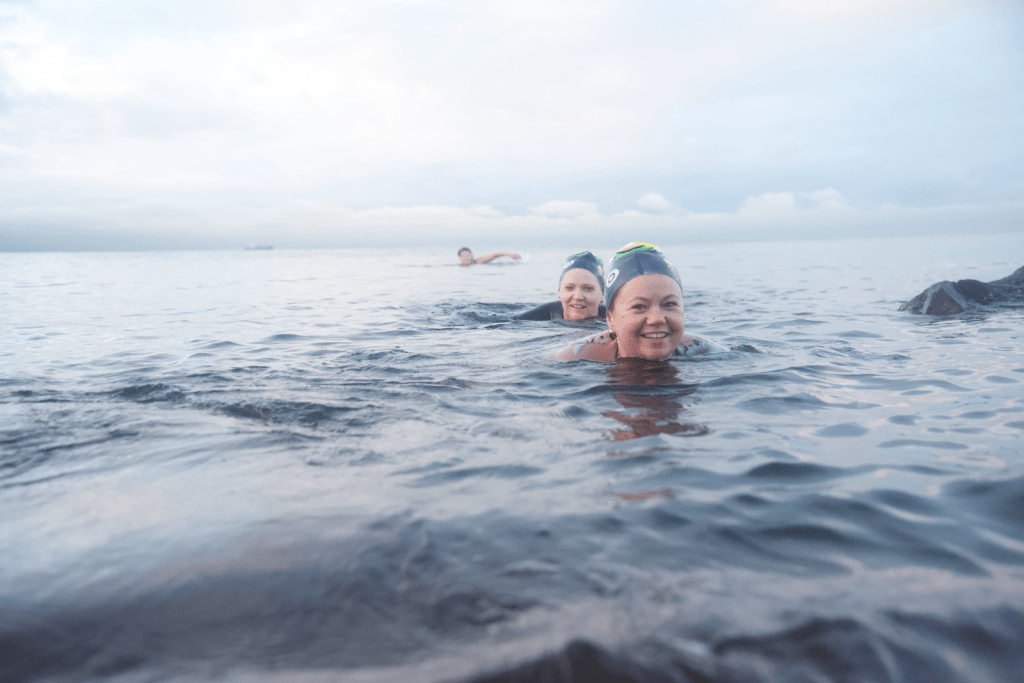
Image Description: Williamstown Jellyfish Swimmers Fiona, Dione and Nicole descend the stairs of ‘The Crystals’
The Williamstown Jellyfish Swimming Club is mostly made up of middle-aged women, and the sense of community and acceptingness Fiona finds when she goes swimming brings her back week after week.
“There’s no barriers. It doesn’t matter whether you’re wealthy, poor, it doesn’t matter your place in society, it’s just getting everyone to be active and swim. Enjoying what we have around us,” she said.
“You could go down there any day by yourself and if you see someone with a Williamstown Jellyfish swimming cap, it’s just accepted that you swim together, no questions asked.”
“Everyone’s welcoming and that’s the vibe and culture that’s being developed.”
In recent years there has been an increased focus on how social health affects physical and mental health, with an 80 year-old Harvard study finding a strong correlation between embracing community and living a long, happy life.
Providing people with third places to form these connections later in life is increasingly important, with a 49% increase in people over 50 experiencing loneliness in the last decade.
Dr Joanne Dolley, research fellow at Cities Research Institute and co-editor of the book Rethinking Third Places: Informal Public Spaces and Community Building, says that third places have value because they make people feel part of their community.
“Third places help to ground people into their neighbourhoods, once you start recognising people in your local community you feel more part of the place” she says.
While conducting social interactions online may provide some of the same social benefits that in-person interactions have, opportunities for incidental interactions are lost.
“If you’re actually at your corner store, your supermarket, or somewhere like that, you will be seeing a more diverse range of people,” she says.
As humans we have a natural tendency to find people like ourselves and form self-selecting social bubbles. Third places encourage people to have a diverse range of interactions and form communities that are more open-minded and cohesive.
Local council and government leaders play a role in fostering and protecting third places, with the ability to fund and maintain community resources.
“Keeping up with the kinds of facilities people want is important, we need to understand what is useful and interesting to the current population,” Dr Dolley says.
“Third places are invaluable for community building and happiness, it is essential in our increasingly digitised world that we continue to protect and foster these social hubs.”
 Elisha Walker